|
Finnish character test measures the dogs range
of features, such as playfulness and
capabilities. Character test doesn’t tell the
whole truth of the dog. Instead, such factors as
behavior of the handler, weather conditions
during the test (heavy rain etc.), the current
mood of the dog and the judge’s range of
experience may affect the result. For example,
the dog easily senses if the owner is nervous
because of the test, and therefore may
over-react in some parts of the tests.
The
test includes sections where tester is expecting
a reaction from the dog. When the reaction
comes, section is for then, over. After the
section, dogs must relax and, for example, go
sniffing for a sleight. If the dog doesn’t relax
the test will be called off.
Despite the downsides of the test, it still
tells something of your dog compared to the
other dogs, who have done the same test. There
are large differences between dog breeds and so
it should be. Police chooses a German shepherd
for its characteristics and a hunter hunting
dog. A family living in the city, wants
companion dog and a sheep farmer a shepherd.
The
problems begin when you buy a dog with features
that do not meet the intended purpose. Poodle is
a companion dog. It’s ancestors, the first
poodles, were retrieving waterdogs. Companion
dogs profile in the character test is different
to one of a shepherd, a service dog or a hunting
dog. When the dog is taken to a character test,
it’s not important how many points the dog
scores, but does it get points from the correct
areas compared to the racial profile.
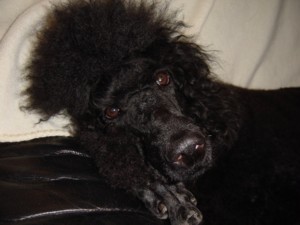
Two examples of a dog,
that scored 200 points.
Character test is judged by two experienced
judges, who together decide of the judging.
Evaluation consists of points, as well as verbal
feedback at the end of the test, where dogs
features are elaborated. A dog cannot be tested
until it is 24-months-old.
For
the time being, there is no officially defined
race profile for the poodles, but in the year
1990 character test work group did unofficial
suggestion to the board of the poodle club. Here
are some main-points of this ”poodles unofficial
race profile”. The suggested breed profile
highlights typical desired features in companion
dogs.
Race definition: Poodle is a companion dog.
Poodle is bright, always alert and diligent. It
is physique is balanced and makes elegant and
proud effect. Moves are flexible and light.
Personality: Poodle is prominently faithful,
easy-learning and easy to train. That’s why it
is particularly a pleasant companion dog.
Eliminating features: Distrustful, aggressive or
too nervous dog.
Poodles personality should be:
- in accordance with race definitions
- suitable for a companion dog
- good for training
-a poodle must be able to adapt to the
surrounding society
Poodle’s features based on the character test
was defined as follows:
-
Desirable
- Acceptable
- Non-desirable
*********************************************************************************************************
I Capacity, multiplier 15
Capacity is a feature, which allows the dog to
act the right way without external compulsory,
the real danger or in the middle of conjectured
signs of danger without being awed and without
interrupting it’s actions. This feature is
primarily comparable to human concept of
“courage”. The test observes particularly the
dog’s ability for organized activity after being
confused or scared.
Desired: +3 very big +2 big +1 decent
Acceptable: -1 small
Undesired: -2 insufficient -3 incapacitated
Comments: A companion dog with courage is far
better option than a companion dog with complete
lack of it.
II Sharpness, multiplier 1
Sharpness means dog’s tendency to react with
hostility as an unexpected stimulus occurs. This
feature tells whether or not or how easily the
dog reacts aggressively to an unknown threat..
Desired: +3 decent without any offensive desire
left +1 small without any offensive desire
Acceptable: +2 big without any offensive desire
Undesired: -1 small with offensive desire -2
moderate with offensive desires -3 big with
offensive desire
Comments: Poodle shouldn’t need to act
aggressively to its environment. As a companion
dog, it is more pleasant without aggressive
features. It is particularly unpleasant, if the
dog reacts aggressively to objects it’s already
familiar with(remaining offensive desire). Race
definition disqualifies aggressiveness.
III defensive desire,
multiplier 1
Defensive desire is an inherited characteristic
to set itself in a dangerous situation to defend
his owner and himself. This grade is meant to
describe dogs natural desire to defend its
intimidated herd (=handler).
Desired: +3 decent, controlled +1 small
Acceptable: +2 big, controlled -1 undesired
Undesired: -2 very big -3 cannot be controlled
Comments: Any kind of uncontrollable defensive
desire is not desired for a poodle. Poodle
doesn’t need to have a defensive desire, but
when controlled it’s no harm.
IV Desire to fight,
multiplier 10
Desire to fight is an inherited tendency to
enjoy the use of jaws and muscles and the
fighting itself. Desire for a playful fight also
indicates the desire to fight. For example, many
dogs love to treat their toys as some kind of
prey. This kind of behavior has its roots in
“desire to fight”.
Desired: +3 big +2 decent
Acceptable: -1 small +1 very big
Undesired: -2 not enough -3 unwilling
Comments: Playful dog is easy to train, though a
poodle’s use as a companion dog will not be
bothered by a small (-1) fighting desire. Low
fighting desire and especially lack of it is
untypical for the breed. Very high fighting will
may turn “mom’s little cutie-pie” into a “every-home’s-nightmare”.
V Nerves (nerve structure),
multiplier 35
Nerve
structure means dog’s inborn calm- or
nervousness which appears when the dog for some
reason gets stressed. This part is the most
important and indicates the endurance of dog’s
nerves. The endurance is shown as capability to
cope with pressure.
Desired: +3 peaceful and confident +2 moderately
peaceful +1 a little restless
Undesired: -1 a little nervous -2 nervous -3
very nervous
Comments: A dog with a bad nerve structure may
be difficult to train and to live with even in
everyday-life. Nerve structure can hardly be
affected by training, which makes this feature
very important. According to race definition
“too much nervousness” is a negative feature.
VI Temperament, multiplier
15
Temperament is an ability to quickly react and
adjust to changing situations. This grade
measures dog’s ability to observe and to
participate what’s happening around him.
Desired: +3 lively +2 moderately lively
Acceptable: +1 very lively
Undesired: -1 disturbingly lively -2 neglecting
-3 apathetic
Comments: Lively, happy, active dog is a nice
companion dog and is easy to train.
VII Mental toughness,
multiplier 8
Mental hardness reflects the toughness of dog’s
personality. (How easy the dog will let
uncomfortable events affect itself.) Dog’s
toughness tells also about the dog’s tendency to
remember displeasing events. A soft dog will do
almost anything to avoid going through any
unpleasant situation doesn’t want to go through
all over again the unpleasant situation it has
once been to, while a tough dog forgets right
away it ever even happened.
Desired: +3 moderately hard +2 hard +1 a little
soft
Acceptable: -1 very hard -2 soft
Undesired: -2 soft -3 very soft
Comments: It is useful for a companion dog to
remember unpleasant happenings quite easily,
though too much softness may cause trouble,
too.. Especially in this valuation you should
make clear to yourself, what is character tests
“soft” dog, because character tests terms differ
from the terms that you may use in everyday
life.
VIII Accessibility,
multiplier 15
Accessibility tells how the dog reacts to a
stranger or a friendly person. An optimal result
would be that the dog would make friends with
the human kindly and openly, but without an
eager to please.
Desired: +3 goodwilling, accessible, open +2
accessible, a little reserved
Acceptable: +1 eager to please
Undesired: -1 clearly reserved -2 attacking -3
unreliable/unpredictive
Comments: Accessibility is very important to
a companion dog. Companion dog should relate
to a human positively.
Gunshot sensitivity
Dogs gunshot sensitivity is tested with a
9mm gun, after the sharpness test while the
dog is attached to a wall or is doing
activities with the owner. Doing activities
is usually moving around with the owner,
sniffing the ground, playing with the owner
etc. (+confident +inexperienced +irritated –prone
to react – afraid)
********************************
This table consist a summary of poodles
profile. You can compare your dogs results
to it.

Test result:
Test result = the final score comes comes
from the final score of the review tables
score, which is between -300 and +300.
An accepted score: The dog reaches
acceptable result, when counted result is at
least +75 and dog has gotten grade +1 in
sharpness, nerve structure and accessibility
and grade + gunshot fearless |